


Integrating HVAC Systems with Smart Home Tech for Energy Savings and Comfort
Smart HVAC integration ties thermostats, sensors, vents and control hubs into a single, automated system so heating, cooling, ventilation and indoor air quality work together — without you having to micromanage them. This guide walks Greater Seattle homeowners and building managers through what smart HVAC integration looks like, how the pieces interact, and why connected climate control can cut energy use while improving comfort. You’ll get a clear technical overview — from local sensors and smart thermostats to cloud controls and voice assistants — plus practical compatibility notes for furnaces, heat pumps and boilers. We also cover predictive maintenance driven by sensors and AI, professional installation, local financing and emergency service options, and the next steps to schedule an assessment. Throughout, we keep the advice vendor-neutral and focused on real, local outcomes.
What Is Smart HVAC Integration and How Does It Work?
Smart HVAC integration links your heating and cooling equipment to intelligent controllers and communication networks so the system can sense conditions, make decisions and act automatically. At a basic level, sensors (temperature, humidity, occupancy) feed control logic that adjusts setpoints, stages equipment and modulates vents through smart thermostats or building controllers. These controllers talk over Wi‑Fi, Zigbee, Z‑Wave or Matter to mobile apps and cloud services. The practical result is less run time when spaces are empty, tighter temperature control where people are, and automatic responses to indoor air quality events — all of which reduce energy use and improve reliability. That’s why correct wiring, compatibility and secure networking matter for a successful install.
What Are the Key Components of Smart HVAC Systems?
Smart HVAC systems are built from a few interoperating parts that together enable automation, sensing and control. Core components include smart thermostats that run schedules and learning algorithms; local sensors that measure temperature, humidity and occupancy; actuators like smart vents and motorized dampers for zoning; a hub or bridge when protocol translation is needed; and cloud/mobile apps and voice assistants for user interaction. Each piece plays a clear role: thermostats set policy, sensors provide the inputs, vents and dampers carry out actions, and cloud services deliver analytics and remote access. Standards like Matter are making cross-vendor compatibility easier, which smooths installs and future upgrades.
- Smart thermostats act as the decision engine for temperature and scheduling.
- Sensors (temperature, humidity, occupancy) feed real-time context to control logic.
- Smart vents and dampers provide room-level actuation for zoning and pressure control.
Together these parts form a simple flow: sensing → decision → actuation → user feedback. That flow also explains how remote control and automation are used day to day.
How Do Smart Thermostats Control HVAC Systems Remotely?
Smart thermostats connect local firmware to cloud services over the home network so mobile apps and voice assistants can read and change setpoints and schedules. The communication path looks like this: thermostat ↔ Wi‑Fi or hub ↔ cloud service ↔ mobile app or voice assistant. That enables features such as adaptive scheduling, geofencing and remote overrides. Good security — strong account authentication and a reliable local-failover mode — keeps basic heating and cooling working if the cloud goes offline. When remote control acts up, troubleshooting typically focuses on signal strength, power (C‑wire) and correct wiring; fixing those usually restores smooth, dependable control and voice integration.
Smart HVAC Integration: Boost Energy Savings & Home Comfort
Smart HVAC integration delivers several practical benefits: lower energy bills, improved comfort through zoning and humidity control, better indoor air quality with coordinated ventilation and filtration, and greater operational reliability thanks to diagnostics and predictive alerts. These outcomes come from reduced runtime in empty spaces, tighter setpoint control that limits overshoot, ventilation triggered by pollutant or CO2 sensors, and analytics that catch problems early. For businesses, integration also supports demand management and occupant comfort policies; for homeowners, it simplifies daily control and produces measurable utility savings.
Different devices deliver distinct value across energy, comfort and reliability:
| Device | Primary Benefit | Typical Outcome |
|---|---|---|
| Smart Thermostat | Adaptive scheduling & learning | 10–12% heating, about 15% cooling savings |
| Smart Vents / Zoning | Room-level temperature control | Increased comfort, reduced complaints |
| IAQ Sensors + Ventilation Controls | Automated fresh air and filtration | Lower allergens, VOC events mitigated |
Smart HVAC integration yields measurable improvements:
- Energy Savings: Automated setbacks and learning reduce run time without sacrificing comfort.
- Localized Comfort: Zoning and sensor-driven control smooth out hot and cold spots.
- IAQ Management: Sensor-triggered ventilation and filtration improve health and productivity.
Those benefits often lead homeowners to seek a local professional evaluation and a safe, reliable installation plan.
At Furnace Doctors Inc., we help Greater Seattle residents capture those gains without the DIY risk. Serving Auburn, Renton and Bellevue, we provide on-site assessments, professional installation and ongoing maintenance for connected HVAC upgrades. We also offer financing and emergency after-hours support. To schedule a compatibility check or discuss smart thermostat installation and system automation, call (206) 622-5018 or (888) 414-HEAT. Our office is at 3210 C St NE Unit #F, Auburn, WA 98002 — so local help is easy to arrange when you’re ready to move from planning to installation.
How Does Smart HVAC Improve Energy Efficiency and Lower Utility Bills?
Smart HVAC systems cut energy use through targeted tactics — adaptive scheduling, occupancy sensing, learning algorithms and staged equipment control — which reduce compressor and burner runtime. Industry data shows smart thermostats typically deliver about 10–12% savings on heating and roughly 15% on cooling when set up correctly and paired with good insulation and air sealing. In Greater Seattle’s mild, wet winters and moderate summers, heating savings often drive most of the payback, especially when heat pumps are optimized and humidity is managed. Knowing how these features work helps you prioritize upgrades that return the most value for your home or business.
- Adaptive schedules prevent unnecessary heating or cooling.
- Occupancy sensing avoids conditioning empty rooms.
- Predictive analytics reduce short‑cycling and long run times.
Those energy gains pair naturally with comfort and IAQ improvements to make systems more pleasant and efficient to live with.
How Does Smart HVAC Enhance Comfort and Indoor Air Quality?
Smart HVAC improves comfort by enabling zoning, humidity control and ventilation that responds to IAQ sensors for particulates, VOCs and CO2. Zoning with smart vents or multi‑stage controls balances temperatures across rooms with different needs, while humidity sensors coordinate dehumidification so spaces feel comfortable without overcooling. Integration with air purifiers and filter-monitoring sensors can automate filtration and prompt timely filter changes, reducing allergens and particulates. Scene-based modes like “sleep” or “away” preserve comfort while saving energy, creating a practical, health-minded approach to home climate control.
- Zoning prevents one room from overheating while others need less conditioning.
- Humidity-aware control cuts mold risk and improves perceived comfort.
- IAQ-driven ventilation brings in fresh air when pollutant levels rise.
| Benefit Area | Mechanism | Expected Result |
|---|---|---|
| Energy | Adaptive learning, occupancy | Lower consumption, reduced bills |
| Comfort | Zoning, humidity control | Stable room temperatures, fewer complaints |
| IAQ | Sensors + ventilation | Reduced allergens and VOC exposure |
Smart automation in HVAC systems offers real, measurable potential to improve indoor air quality and overall system performance.
Building Automation’s Impact on IAQ and HVAC Performance
Building automation can make indoor air quality better and HVAC systems more efficient by letting ventilation and filtration react to real-time conditions. That responsiveness improves occupant comfort and cuts wasted energy, creating healthier, more efficient buildings.
Impact of Building Automation on Indoor Air Quality and HVAC Performance, 2023
How Does Furnace Doctors Inc. Provide Smart Thermostat Installation and HVAC Automation Services?
Our process starts with an on-site compatibility assessment, then moves to wiring and control planning, device installation, commissioning and customer training so your system delivers the promised savings and comfort. During the assessment we check for power needs (like a C‑wire), confirm thermostat compatibility with furnaces, heat pumps or boilers, and identify relay or adapter needs for legacy equipment. Installations follow safe wiring practices and include schedule setup, geofencing and voice integration where requested, plus documentation of settings for you. After install we test the system, verify IAQ sensors and zoning actuators, and make sure you know how to use the new features comfortably and confidently.
- Assessment: Verify compatibility and recommend upgrades.
- Installation: Safe wiring, mounting, and system integration.
- Commissioning: Test sequences, app setup, and user training.
What Is the Professional Smart Thermostat Installation Process?
A professional install begins with a site survey to document control wiring, check for a C‑wire and note any multi‑stage or heat‑pump requirements. Once compatibility is confirmed, technicians install the thermostat or control hub, wire relays or adapters if needed, add sensors or smart vents, and run functional tests across heating, cooling and fan modes. The final steps include configuring the mobile app, setting initial schedules or learning parameters, linking voice assistants if desired, and walking you through remote controls and basic troubleshooting. This full-service approach ensures the thermostat does more than show a temperature — it actively participates in zoning and IAQ strategies.
- Verify C‑wire and control signals before install.
- Install relays or adapters for legacy systems when needed.
- Test sequences and train the customer for daily use.
Understanding these steps helps you prepare for the visit and sets expectations for financing and after-hours support.
Which HVAC Systems Are Compatible with Smart Home Technology and Platforms?
Most modern furnaces, heat pumps and air conditioners can work with smart thermostats; some older boilers or specialty gear may need relays, smart adapters or a control interface to automate safely. Compatibility hinges on control signals (single‑stage, multi‑stage, or heat‑pump reversing valves), a common power connection for smart thermostats, and whether equipment uses proprietary controls that require a bridge. Integration with Amazon Alexa, Google Home and Apple HomeKit usually goes through vendor apps or a hub that translates commands; Matter is improving cross‑vendor interoperability for devices that support it. Knowing your control signals and power availability makes the retrofit decision clearer: add a relay, fit an adapter, or replace the controller as needed.
| HVAC Type | Compatibility Notes | Typical Upgrade Needed |
|---|---|---|
| Furnaces | Generally compatible with modern smart thermostats | C-wire or relay for older units |
| Heat Pumps | Compatible with heat-pump-capable thermostats | Verify O/B reversing valve signals |
| Boilers | Varies; many can be controlled via relay interfaces | Relay or smart boiler controller |
Can Older Furnaces, Heat Pumps, and Boilers Be Upgraded for Smart Integration?
Yes. Older systems are often retrofittable, though the work ranges from simple to complex depending on wiring and control types. Typical retrofit steps include adding a C‑wire or external power module for thermostat power, installing smart relays for on/off or staging, and using interface modules for boilers with circulators or zone pumps. If equipment is near end‑of‑life or lacks a safe retrofit path, replacing the unit with modern, compatible gear may be more cost‑effective. A professional assessment will tell you whether an adapter, a relay, or a replacement is the right, safe choice.
- Add a C‑wire or power module for thermostat power.
- Use smart relays or interface modules for legacy controls.
- Replace equipment when retrofit is impractical or unsafe.
Next: how these systems connect to voice assistants and smart home platforms.
How Does Smart HVAC Automation Enable Predictive Maintenance and System Diagnostics?
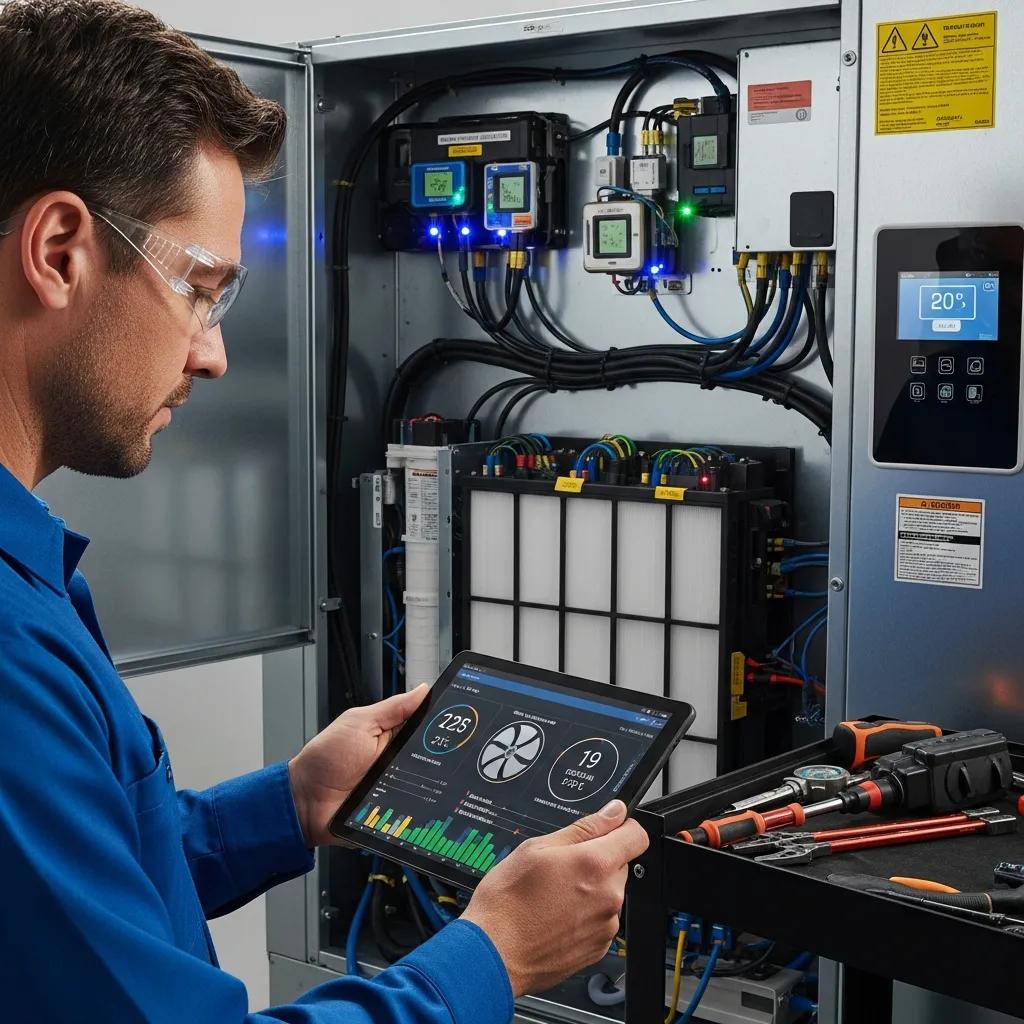
Smart HVAC automation enables predictive maintenance by continuously collecting operational data — runtime, cycle frequency, current draw and vibration signatures — and applying analytics to spot anomalies before they become failures. Sensors and cloud analytics can flag trends like rising compressor current, extended run times or pressure swings that point to wear, refrigerant loss or airflow restrictions. Those alerts let technicians schedule repairs at convenient times, replace parts before they fail, and avoid costly emergency breakdowns. The net result is fewer emergency calls, steadier efficiency and longer equipment life.
| Sensor / Feature | Monitors / Measures | Benefit / Outcome |
|---|---|---|
| Current draw sensors | Compressor and motor load | Detects bearing wear or refrigerant issues early |
| Vibration sensors | Mechanical imbalance | Flags imminent mechanical failures |
| Runtime & cycle analytics | On/off patterns | Identifies short-cycling and efficiency loss |
What Sensors and AI Technologies Monitor HVAC Performance?
Common inputs include temperature, humidity, occupancy, current draw, pressure differentials and vibration sensors. AI tools perform anomaly detection, trend analysis and prognostics using those signals. For example, rising compressor current plus longer run times can be flagged as a likely precursor to compressor trouble, while vibration changes may predict motor or blower faults. Machine learning models learn each unit’s normal behavior over time, which reduces false alarms and helps technicians focus on real early‑warning signs. Connecting these sensors into service workflows turns alerts into prioritized, actionable jobs rather than noise.
- Temperature and humidity sensors provide an environmental baseline.
- Current draw and vibration sensors detect mechanical stress.
- AI analytics correlate multi‑sensor signals for predictive alerts.
These monitoring capabilities support maintenance programs that extend equipment life and reduce emergency service needs.
How Does Predictive Maintenance Extend HVAC System Lifespan?
Predictive maintenance extends life by spotting small faults early, timing replacements more effectively, and avoiding stressful operating patterns such as short‑cycling or sustained high load. Fixing issues like clogged filters, refrigerant drift or motor wear before they escalate prevents cascading failures that often lead to major component replacement. Benefits include fewer emergency calls, steadier efficiency and a longer period before full system replacement is needed. For example, catching a slow refrigerant leak early allows a controlled repair that protects the compressor and preserves performance.
- Early detection prevents catastrophic component failures.
- Scheduled repairs maintain efficiency and reduce energy waste.
- Long-term, predictive strategies lower total cost of ownership.
Those maintenance advantages are part of why professional integration and local, responsive service matter to Seattle‑area property owners.
Conclusion
When done right, smart HVAC integration improves energy efficiency, comfort and indoor air quality while reducing unexpected breakdowns. Automation and predictive maintenance deliver real savings and peace of mind. If you’re in the Greater Seattle area and want a local team to design, install and support a smart HVAC solution, contact Furnace Doctors Inc. to explore options tailored to your home or building.